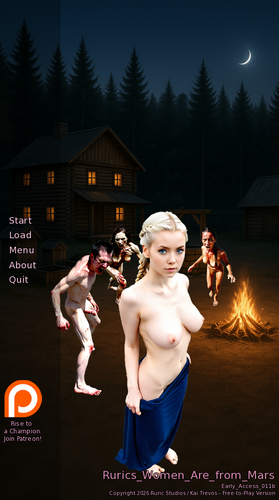
Ruric's Women Are from Mars
Version:1775066975
Published:2026-07-29
Introduction
Ruric's Women Are from Mars places you in a dying Martian biodome as a single-player, adult-themed cinematic strategy novel where survival, politics and intimate bonds determine your legacy. Ruric's Women Are from Mars begins when Ruric wakes from 272 years of cryostasis into a world of roving undead, rival commander factions and brutal pit fights; the experience blends branching narrative with base and house-building, social systems and tactical choices to shape both immediate survival and long-term dominance. This description outlines mechanics, controls, progression and accessibility so you know what to expect before downloading.
Gameplay Overview
The core gameplay balances choice-driven storytelling with practical survival systems. You will make dialogue and action choices that influence faction relationships, personal loyalties and the social rank of your household. Outside conversations, resource management and territory control are important: scavenge or seize supplies, maintain shelter integrity, recruit or discipline followers, and decide when ritual obligations outweigh tactical needs. Combat appears through staged encounters such as pit fights and skirmishes with undead or rival commandos; these encounters emphasize decision-making and planning rather than twitch reflexes.
Controls and Interface
The interface is optimized for touchscreen play. Dialog choices and narrative branches use clear, tappable options. Base and house-building placement is handled through drag-and-drop gestures and contextual menus that allow rotating and positioning structures on a simple grid. Quick-access panels let you review resources, assign tasks to followers and inspect ritual options. Accessibility settings include adjustable text size and optional auto-advance for conversations to reduce repetitive tapping during long scenes.
Progression and Base Building
Progression is narrative and mechanical. Advancing your standing with commanders and houses unlocks new rituals, construction blueprints and household ranks. Base-building focuses on claiming territory and establishing a functional house: secure resource nodes, upgrade defenses, allocate living quarters and create ritual spaces that grant buffs or unlock story beats. Progress is persistent within each playthrough and choices have weight—alliances and rivalries determine which upgrades and story paths remain available.
Relationship Mechanics and Rituals
Relationships are a central layer that interacts with survival systems. Loyalty, influence and reputation are tracked through visible meters and episodic events. Rituals function as both narrative devices and gameplay mechanics: performing or refusing rites affects follower morale, resource consumption and geopolitical standing. The game treats mature themes in a narrative context, presenting them as part of the setting and character development rather than titillation; it is intended for mature players and includes content warnings in relevant sections.
Visual Style and Audio
The visual approach is cinematic and moody, with a focus on atmospheric lighting, ruined biodome architecture and character-driven close-ups during key scenes. Environments range from corroded living quarters to arena pits and overgrown agricultural bays, each designed to support decisions about exploration and base placement. The soundscape complements the writing with ambient effects, subdued score and clear voicework in key sequences to sustain immersion while keeping system requirements approachable for most modern Android devices.
Customization and House Management
Customization centers on your house and household rather than explicit individual character modifications. You can choose house layouts, decorate ritual chambers and assign roles to followers which changes how tasks are performed and how confrontations play out. These visual and functional choices let you tailor a playstyle focused on diplomacy, brute force or ritual influence, and they visibly affect how other factions respond to you in the world.
Replay Value and Endings
Ruric's Women Are from Mars offers significant replay value through branching narratives, shifting faction allegiances and multiple possible legacies. Different strategies—prioritizing resource control, relationship-building or ritual power—open distinct story arcs and endings. Because many decisions have delayed consequences, subsequent playthroughs reveal new interactions and unlock previously unavailable content, encouraging exploration of alternative approaches to leadership in the biodome.
Accessibility, Offline Play and Performance
The game is designed as an offline single-player experience so you can play without a persistent internet connection. Performance options allow reduced visual effects for older devices, and accessibility features such as text scaling and simplified input modes help accommodate different play styles. Save slots and a clear chapter structure let you manage progress and return to the story at your own pace.
Challenge Systems and Balance
Challenge comes from resource scarcity, political tension and the consequences of rituals. Combat encounters emphasize tactical choices like positioning followers or wagering resources in pit fights rather than real-time fighting, while political challenges require careful negotiation and timing. Difficulty settings tune resource availability and encounter severity so both story-focused players and those seeking a tougher strategic test can find an appropriate experience.
Final Notes
Ruric's Women Are from Mars is a dark, character-led strategy novel for mature audiences that combines narrative depth with tactical base management and social systems. If you enjoy morally complex stories, atmospheric worldbuilding and strategic decision-making that reshape the course of a playthrough, this title offers a dense single-player experience with meaningful replay potential.
Show More