It Could Be
Version:1.0
Published:2026-08-04
Introduction
It Could Be is a compact, character-driven visual novel that follows Dusty as he navigates two overlapping relationships with wolves Lugh and Randall across different moments of his life. This single-session narrative, built around roughly 3,400 words of text and supported by sprite and CG artwork, offers a focused storytelling experience that emphasizes mood, character interaction, and careful pacing rather than traditional game mechanics. It Could Be is well suited for readers who want a short, atmospheric scene-driven piece that can be completed in one sitting while still leaving space for reflection on the characters and themes.
Key Features
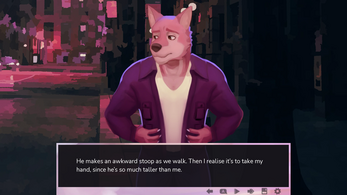
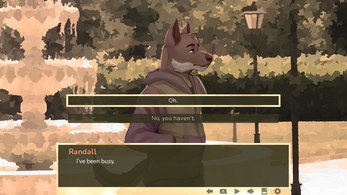
Approximately 3,400 words of interleaved scenes present Dusty’s adult life in Seattle against memories from a Dallas suburb, delivering a dual-time narrative that gradually reveals emotional context and character history. The presentation is text-first: the writing carries the story while sprites and occasional CGs provide visual emphasis for key moments. The layout is designed to be consumed on mobile devices with a simple, readable interface that keeps attention on dialogue and internal monologue. Fans of literary visual novels will find the focus on atmosphere and character beats to be the core appeal of It Could Be.
Gameplay and Controls
Gameplay is intentionally minimal and accessible: players progress by advancing the text at their own pace, which makes the experience feel more like reading a short story than playing an action title. Typical input methods on mobile—tapping the screen to advance lines and tapping or swiping to move between scenes—are natural here, and the structure avoids complex menus or layered mechanics. Because the narrative is compact and linear, the control scheme is streamlined so readers can focus on tone and subtext without learning new systems.
Progression, Replay Value and Structure
The progression is scene-based rather than level-based: the story shifts between present-day and past moments in interleaved chapters that build emotional resonance through juxtaposition. There are no lengthy grind loops or progression trees to navigate; instead, the primary reward is narrative completion and the gradual accumulation of context. Replay value comes from revisiting specific scenes to notice different details in the writing or art, and from rereading passages to appreciate subtle character beats. While the main thread is compact and largely linear, attentive readers may find new meanings on subsequent playthroughs.
Visual Style and Presentation
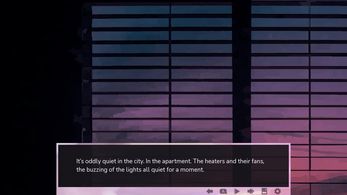
The visual approach pairs clean sprite work with a handful of CG images that punctuate important beats without relying on explicit imagery. Art credits are included in the package, and the overall color palette and character design support the emotional tone of each scene. Text is presented clearly with readable typography and scene breaks that allow pauses for reflection. The visuals act as a complement to the writing, adding expression and atmosphere while keeping the focus on character interaction.
Customization, Accessibility and User Experience
User-facing customization is kept minimal to preserve the literary rhythm of the piece: the interface emphasizes legibility and ease of navigation rather than deep UI personalization. The reading experience is accessible to a wide audience by design—text sizes and contrast on most devices make the story easy to follow, and the simple control model reduces barriers for new users. The app is suitable for offline play once installed, so the narrative can be enjoyed without a persistent network connection. The experience is best suited to users who prefer calm, contemplative content over fast-paced gameplay.
Challenges and Suitable Audience
There are no action-based challenges or timed sequences; the primary challenge is interpretive, asking players to pay attention to emotional cues and how scenes across time inform character decisions. This makes the title a fit for players who enjoy literary pacing, character study, and compact storytelling rather than branching game systems or mechanics-driven progression. The writing includes mature themes and frank language, so readers should expect adult-oriented text without explicit visual content.
Development Team and Credits
The visual and interface elements accompanying the narrative are credited to Sprite Artist: weptmac, CG Artist: sikyu, and UI Code: ErebusWulfe. These contributors give the short story a visual identity that supports the text-first experience. For players seeking a brief, emotionally focused reading experience on mobile, It Could Be offers a polished, single-session visual novel where strong character moments and careful writing are the primary attractions.
Show More