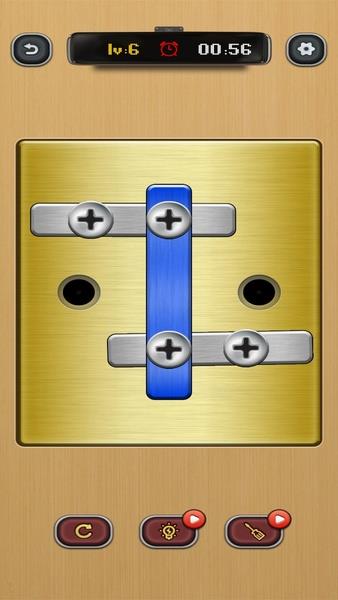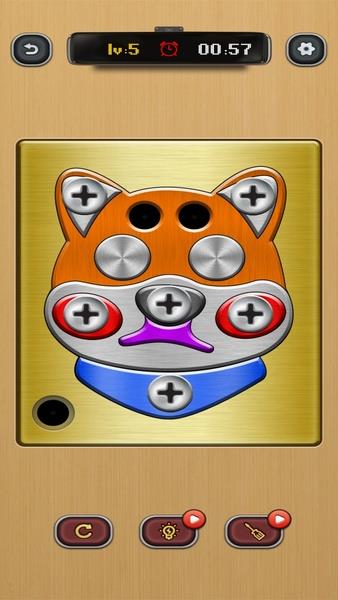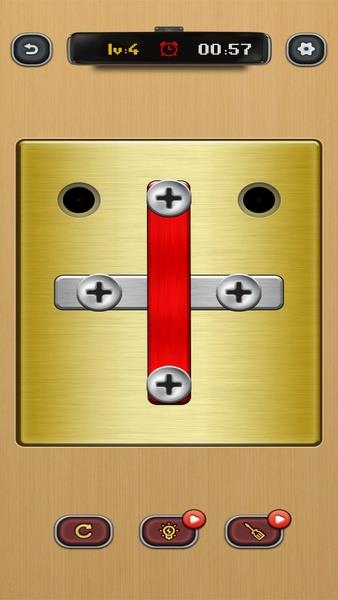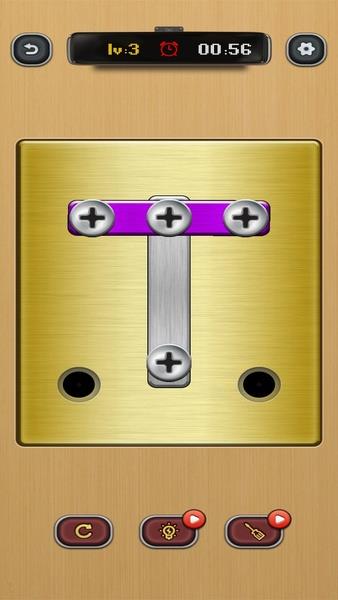
Screw Master
Version:1.0
Published:2026-08-05
Introduction
Screw Master places you in a hands-on mechanical puzzle environment where the aim is simple to state but often intricate to achieve: unscrew pins, remove bolts, lift rings and free trapped metal pieces from tangled assemblies. In Screw Master each level is a compact machine to be understood and dismantled through deliberate taps and swipes, careful timing and spatial reasoning. The description below explains how the game plays, what to expect from its pacing and presentation, and how its design supports both casual sessions and longer, focused problem solving.
Gameplay Mechanics
The core gameplay revolves around a few consistent interactions: turning or nudging screws, sliding plates, pulling rings and undoing knots in corded constraints. Physics-driven components respond to player input, so an unscrewing action can change how nearby parts settle or obstruct new paths. Puzzles often combine sequences of small steps rather than a single trick, encouraging observation before action. Levels are designed to reward methodical approaches; trying to force a component will usually reveal that a different order of operations or a small repositioning of a piece is needed to progress.
Controls and Accessibility
Controls are intentionally simple and tactile: tap to select, drag to turn or slide, and use short swipes for quick nudges. Control sensitivity and gesture size can be adjusted in settings to suit different devices and hands, and an optional step-by-step tutorial introduces the basic maneuvers on early levels. Accessibility considerations include contrast-friendly visuals and the ability to increase interactive targets for players who prefer larger touch areas. Small helper hints can be enabled for players who want occasional guidance without a full walkthrough.
Progression and Level Structure
Screw Master unfolds through a progression of levels that introduce new mechanics gradually. Early stages focus on basic unscrewing and simple tangles; later puzzles layer multiple mechanics so that players must sequence actions and anticipate the mechanical consequences of each move. Checkpoints within more involved levels allow you to experiment without restarting entirely, and optional higher-difficulty variants present the same layout with tighter constraints for players who want additional challenge. This steady increase in complexity keeps the objectives clear while expanding the skill set required to solve the most intricate assemblies.
Visual Style and Audio
The visual presentation emphasizes materials and motion rather than flashy effects: brushed metal, worn screws, and realistically behaving ropes give each puzzle a believable mechanical feel. Subtle animations show how parts respond to changes, which helps players learn through observation as well as interaction. Sound design follows the same restraint, with tactile clicks, soft metallic scrapes and ambient tones that provide feedback without overwhelming focus. The overall aesthetic supports concentration and the tactile satisfaction of a well-executed unscrew or release.
Customization and Replay Value
While the central challenges remain puzzle-focused, built-in options let you tailor the experience to your taste: switch between visual themes that emphasize contrast or subdued tones, and choose a control scheme that feels most comfortable. Many levels include optional objectives or alternate solutions, which encourage replay to discover different approaches and timing. Because puzzles are solvable through observation and planning rather than reflex alone, players can return to earlier stages to refine techniques or try new strategies without feeling penalized for experimentation.
Offline Play and Performance
The game is optimized for single-device play and does not require an active internet connection for its core puzzles, making it suitable for flights, commutes or any situation where connectivity is limited. Performance-friendly rendering and lightweight assets mean Screw Master runs smoothly on a range of phones and tablets, and battery-conscious design keeps sessions comfortable during extended play. Save states and local progress tracking ensure you can pick up where you left off.
User Experience and Challenge Systems
Player experience centers on a calm, deliberate rhythm: observe, plan and execute. An optional hint system offers graduated nudges rather than full solutions, helping players learn problem-solving patterns over time. Difficulty balancing aims to keep frustration low while preserving meaningful challenge; when a level feels blocked, the design encourages players to step back and reassess rather than rely on repetition. Together, these systems make Screw Master a puzzle title that rewards patience, careful reasoning and the small satisfactions of mechanical problem solving.
Show More