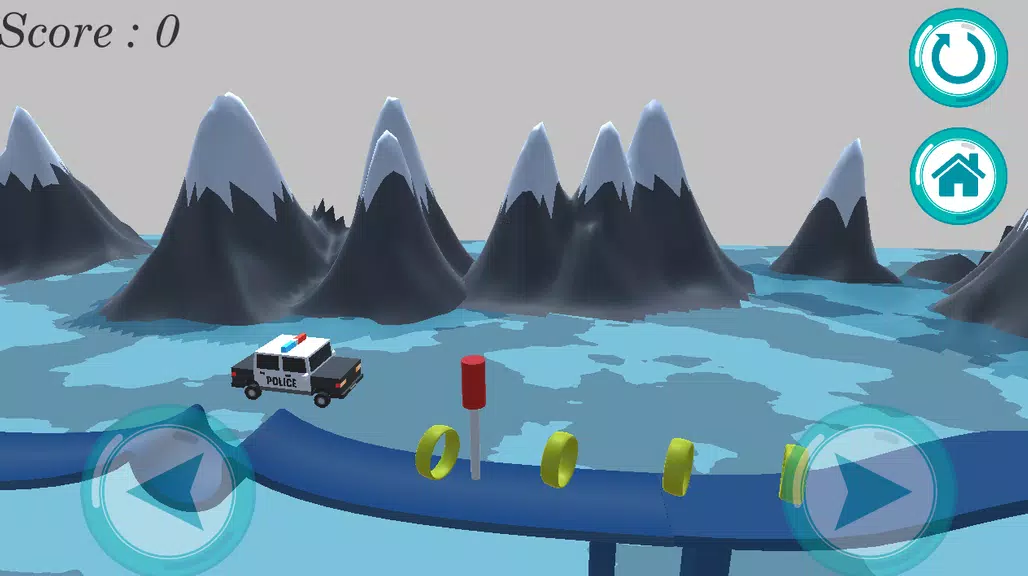
Risky Road Driver
Version:39.9
Published:2026-08-06
Introduction
Risky Road Driver places you behind the wheel of stunt-ready cars in a physics-driven driving experience that balances simple controls with increasingly demanding obstacle courses. In Risky Road Driver the emphasis is on timing, balance and creative use of ramps and uneven terrain rather than traditional circuit racing; missions are structured to reward precision and repeated practice as you learn how each vehicle responds to throttle, brake and tilt inputs. The first impression is approachable: tutorials introduce core mechanics, while later stages reveal tighter tolerance windows and sequences that require deliberate control and composure.
Gameplay and Controls
The core gameplay loop focuses on navigating short, stunt-heavy levels where balance and momentum determine success. Controls are intentionally minimal: a throttle input that governs forward power, a brake/reverse control for quick recovery, and a tilt or lean mechanic that adjusts vehicle pitch during jumps and on narrow platforms. These inputs combine with a simple but responsive physics model to produce an organic feel — getting a run right requires subtle adjustments rather than complex button combos. Touch controls are optimized for accuracy, and the game supports alternative control sensitivity settings so you can tailor steering and tilt responsiveness to your preference.
Progression and Unlocks
Risky Road Driver uses a mission-based progression system where completing objectives opens the next set of courses and grants access to new vehicles. Early missions teach the fundamentals of momentum and balance, while later missions increase difficulty through longer sequences, steeper ramps and hazards that punish sloppy landings. Progression is clear and measurable: each mission typically has primary completion criteria and optional challenge targets that reward improved performance with additional unlocks. The gradual ramp in challenge encourages repeat play and incremental improvement rather than one-off attempts.
Visual Style and Level Design
The game favors a clean, readable visual style that highlights hazards, ramps and interactive objects so players can focus on timing and movement. Levels are composed of compact stunt arenas with distinct visual themes — urban rooftops, desert plates and industrial ramps — each designed to teach or test a particular skill. Lighting and camera choices emphasize vehicle motion and provide helpful angles for planning jumps. Visual polish is applied selectively to keep frame rate consistent on a wide range of devices while preserving the clarity needed to judge distances and takeoffs.
Customization and Vehicles
A selection of vehicles is available to discover as you complete missions, and each one handles slightly differently to encourage experimentation. Vehicles range from lightweight stunt buggies to heavier cars with distinct center-of-gravity behavior; this variety affects how they respond to throttle and tilt, creating meaningful differences without overwhelming complexity. Cosmetic customization options and minor tuning adjustments — such as suspension stiffness or tire grip settings — can be unlocked to fine-tune handling for specific courses, helping players tailor their experience without introducing opaque upgrade systems.
Challenge, Replay Value and Level Structure
Levels are short by design, which enhances replay value: a single run might last just a minute, but mastering a sequence often requires repeated attempts to refine timing and muscle memory. Optional challenge tiers on each level create reasons to revisit older stages with new vehicles or settings, and the mission structure mixes straightforward objectives with riskier, high-reward maneuvers. Because physics outcomes can vary subtly between attempts, each replay feels fresh as you try different approaches or vehicle setups to shave seconds or avoid penalties.
Accessibility and User Experience
The interface and progression are approachable for casual players while still offering depth for those focused on mastery. Adjustable control sensitivity, a tutorial that demonstrates basic maneuvers, and clear visual feedback on landings and balance make the game accessible to a broad audience. The UI minimizes clutter so players can concentrate on timing and vehicle posture, and optional hints help new players understand why a run failed without hand-holding through the entire level.
Offline Play and Performance
Risky Road Driver is designed to be playable offline, allowing users to tackle missions without a constant network connection. This makes it convenient for short sessions on the go and reduces latency concerns for input timing. Performance tuning prioritizes consistent frame rates across a range of devices to ensure physics remain predictable and responsive during stunt sequences.
Known Limitations and Final Notes
Because the game focuses narrowly on stunt driving, it does not attempt to replicate full-scale racing careers or in-depth vehicle simulations; players seeking expansive open-world racing or deep mechanical tuning may find the scope limited. That said, Risky Road Driver delivers a focused stunt driving experience with an approachable learning curve, varied vehicle handling, and mission design that encourages iterative improvement and replayability.
Show More