Wife Promotion
Version:3.0
Published:2026-08-23
Introduction
Wife Promotion is a netorare-themed visual novel that places you in the tense, emotionally charged role of a husband navigating jealousy, temptation, and the shifting dynamics of a strained marriage; Chapter 3 continues the narrative and introduces new scenes that push the story into darker and more ambiguous territory while preserving a close, character-driven perspective. Wife Promotion presents the plot through tightly written dialogue and a close third-person viewpoint so players feel the weight of each choice and the immediate consequences that follow. The title emphasizes interaction and narrative detail rather than action mechanics, offering a compact but immersive reading experience built around character psychology and emotional stakes.
Key features and narrative structure
The narrative unfolds across chapters, with Chapter 3 expanding the cast of secondary characters and complicating existing relationships in ways that change how prior decisions are interpreted. Decision points occur at meaningful moments and steer tone, trust dynamics, and later scene availability; choices can close certain routes or open new conversational beats that alter the emotional trajectory. The structure is primarily linear between chapters but includes branching nodes that lead to multiple outcomes, encouraging players to weigh short-term impulses against long-term consequences. Scenes are presented as paced episodes rather than quick vignettes, allowing time for tension to build and for subtle reactions to register.
Gameplay mechanics and controls
Gameplay centers on careful reading, selecting responses at narrative forks, and managing scene flow. Controls are simple and optimized for touch devices: tap to advance text, use on-screen buttons to choose lines of dialogue, and access a dialogue log to review what has already been said. Standard visual novel conveniences—auto-play, text skip for previously read content, and quick save/load—are included so you can tailor pacing without losing immersion. The interaction model is deliberately low-friction to keep attention on the writing and character beats; this design keeps mechanical distractions to a minimum while allowing players to focus on the emotional and moral decisions the story presents.
Progression, chapters, and pacing
Progression is chapter-based and decision-driven: reaching specific choice nodes unlocks later chapters and branch paths, while checkpoints and save slots let you experiment without replaying earlier material from scratch. Chapter 3 functions both as a continuation for returning players and as a concentrated segment that deepens motives and raises stakes for later chapters. Pacing balances introspective, dialogue-heavy scenes with moments of confrontation to maintain momentum; the game is structured so that revelations and character choices feel earned rather than abrupt. These systems make it straightforward to explore alternate routes and to revisit particular moments to see how different responses reshape relationships.
Visual style and presentation
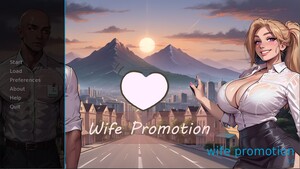
Wife Promotion’s art direction favors intimate character portraits, expressive facial detail, and moody background imagery that underline the story’s emotional tone. Sprites and background art adapt subtly to reflect mood shifts, using lighting, color, and small pose changes to highlight tension during pivotal scenes. The UI is intentionally unobtrusive—text boxes, fonts, and on-screen buttons are designed to keep focus on dialogue and character interaction. Subtle transitions and ambient sound cues mark turning points in the narrative without relying on flashy visual effects, preserving a quiet atmosphere that supports immersion and reading comfort.
Customization and accessibility
Several options help tailor the reading experience: adjustable text speed, font size, and display contrast support different reading preferences and visual needs. A readable dialogue log and chapter navigation tools assist players in following complex interactions or reviewing missed lines, while simple interface scaling helps accommodate different screen sizes. These accessibility choices make it easier for players who prefer a slower pace, need more time to process scenes, or require larger text to comfortably engage with the story.
Replay value and player experience
Replayability stems from branching choices and their emotional consequences: returning to earlier decisions reveals alternate character reactions and can unlock different endings or late-game scenes. The game rewards attention to dialogue and to the way relationships shift over time, encouraging multiple playthroughs to explore how trust, regret, and loyalty evolve under different pressures. Rather than mechanical difficulty, the title offers moral and emotional challenge—making choices that feel meaningful and seeing their ripple effects—so players who enjoy character study and layered storytelling will find value in revisiting the narrative.
Offline play, performance, and system considerations
Once installed, Wife Promotion is playable offline and optimized for smooth performance on typical Android devices; it does not require a persistent internet connection. The balance between file size and graphical scope keeps load times short while maintaining the atmosphere of each scene, and low background resource use allows extended reading sessions without excessive battery drain. The game is built to run consistently across a wide range of hardware, prioritizing stable frame presentation for transitions and uninterrupted text rendering.
Content notes and audience
This is a mature, character-focused story that examines jealousy, relationship strain, and morally complex scenarios in a measured and non-exploitative way; it does not include explicit sexual descriptions but does treat adult themes candidly. The netorare elements and morally ambiguous choices can be unsettling for some players, so the title is best suited to readers who appreciate intimate psychological drama and narrative depth rather than lighthearted or action-oriented gameplay. If you prefer straightforward mechanics or purely upbeat stories, this game’s reflective and tension-driven approach may not be the right fit.
Show More