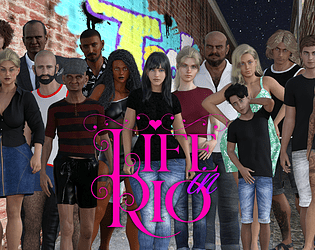
Life in Rio
Version:0.2
Published:2026-09-10
Introduction
Life in Rio drops players into a tightly written, choice-driven visual novel set against the vivid and dangerous backdrop of Rio de Janeiro. You play as Elza, a young woman raised under strict church doctrines whose life is forced into upheaval by a sequence of events that challenge her faith, relationships, and moral compass. Life in Rio focuses on decision-making: each choice steers branching storylines, opens different scenes, and contributes to multiple possible endings, so your path through the city and its characters changes with every playthrough.
Key Features
The core gameplay centers on selections presented at key story moments; choices are selected with simple taps or clicks and are reflected immediately in the narrative and character responses. The game is structured into chapters and scenes that form a branching node map, allowing you to revisit chapter checkpoints and explore alternative branches without replaying unchanged material from the start. Optional segments expand the main plot by offering short interludes where Elza is absent, bringing additional perspectives and variety to the overall arc. The narrative contains mature themes and explicit material; those sections are presented as part of the story and can be managed through the content visibility settings found in the options menu.
Controls and Progression
Controls are designed for straightforward reading and choice selection: tap or click to progress lines of dialogue, use the on-screen menu to access save slots, quick load, and the chapter map. Progression is tracked by choice history and unlockable branches, so decisions you make earlier can unlock new scenes later in the game. Multiple manual save slots and an autosave option make it easy to experiment with different paths, and a built-in chapter list helps you jump back to earlier points to try alternative decisions without losing overall progress.
Visual Style and Performance
The visual presentation emphasizes character-driven scenes and a gritty urban palette that evokes Rio’s dense neighborhoods and contrasting social textures. Artwork and atmosphere aim to support the story tone rather than flashy effects, keeping focus on character expressions and setting detail. The developer notes that visuals and performance are evolving: early builds were produced on integrated graphics, and planned hardware upgrades are intended to improve rendering quality and frame stability over time. Because the project is compact by design, it remains accessible on modest devices while benefiting from incremental visual updates.
Customization and Accessibility
Life in Rio includes several user options to tailor the reading experience. Adjustable text speed, an auto-play mode for hands-free reading, and a skip-read option for previously seen dialogue help manage pacing. You can toggle explicit content visibility so that more sensitive scenes are hidden during a play session if you prefer; this preserves narrative coherence while offering content control. Accessibility settings include font size adjustment and contrast-friendly text boxes to enhance readability for players with varying needs.
Replay Value and Challenge
Replayability is built into the narrative architecture: branching decisions, multiple endings, and optional off-Elza segments create incentive to revisit the story and probe different moral outcomes. The game’s challenge is primarily narrative and ethical rather than reflexive—players are tested by dilemmas that trade short-term gain against long-term consequence, and by social pressures that alter character relationships. Discovering alternative routes and resolving character arcs differently provides the main reward for replaying chapters.
User Experience and Offline Play
The experience is designed to be single-player and fully playable offline after installation, making it convenient for travel or areas without stable connectivity. The interface emphasizes minimal clutter so readers can focus on dialogue and choices; simple menus provide clear access to saves, settings, and scene navigation. Because the scope is intentionally compact, sessions can be short or extended depending on how deeply you explore branches, which supports relaxed or systematic play styles.
Development and Known Limitations
The creator of Life in Rio is an independent developer working with limited hardware resources and iterating on the project over time. Current builds may show room for visual polish and performance optimization due to development on an integrated GPU, and the developer has indicated plans to upgrade to a dedicated graphics card to improve textures and frame consistency. The team welcomes player feedback and issues reports to guide further improvements while preserving the game’s narrative focus.
Content Advisory
Life in Rio contains mature themes and explicit material intended for adult audiences. The game’s treatment of those themes is narrative-driven and sometimes unsettling by design; players who wish to avoid explicit scenes can use the content toggles and chapter navigation to manage what they see. The description aims to provide a clear, neutral overview so you understand the tone and mechanics before installing.
Show More