Project Wild One
Version:0.06
Published:2026-09-11
Introduction
Project Wild One is a rapid turn-based adventure that places player freedom and dynamic NPC interactions at the core of its experience. In this early-access title you control a powerful protagonist who navigates a sequence of distinct locations, resolving encounters through a sandbox of approaches that range from persuasion and social tactics to direct confrontation; several mechanics that some players may find mature or adult-oriented are optional and can be toggled before a run. The game emphasizes emergent outcomes rather than scripted solutions, so choices in dialogue, positioning, and ability use change how scenarios unfold and how NPCs react over time.
Gameplay and encounter design
The encounter system in Project Wild One is designed for rapid, focused turns that reward experimentation. Each encounter presents a small, self-contained situation with multiple viable resolutions: negotiation and social strategies affect NPC disposition, environmental options can be used to gain advantages, and combat remains a straightforward, tactical alternative. Encounters are built from modular components so the same scenario can produce different results depending on player decisions and the evolving state of NPC AI. This design supports both short play sessions and longer exploratory runs where the consequences of earlier choices cascade into later encounters.
Controls and user interface
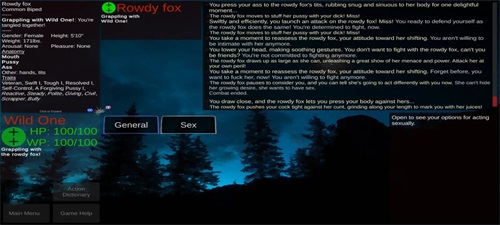
Controls are optimized for touch play on mobile devices with clear tap and drag interactions for selecting targets, moving through the encounter area, and applying abilities. The UI keeps core information visible—health and status indicators, NPC intent cues, and contextual action prompts—without obscuring the scene. Tooltips and an optional tutorial introduce mechanics gradually so new players can learn pacing and tactical options; advanced players can disable tutorials and enable faster UI transitions for a more streamlined session.
Progression, challenge and replayability
Progression is centered on unlocking new encounter types, abilities, and encounter modifiers rather than a linear leveling system. As you experiment, you unlock additional tools that change how situations can be approached, and the game tracks narrative variations that make subsequent runs feel different. A lightweight challenge system lets players choose encounter difficulty and the prevalence of certain mechanics to tune risk versus reward. Because NPC AI is reactive and encounters are modular, the game offers high replay value: the same map area can yield new story beats and tactical opportunities when different strategies are used.
Customization, accessibility and play options
Customization is a key focus: most mechanics that could be considered mature are optional and can be turned on or off before a playthrough, letting players tailor the experience to personal comfort levels. Difficulty settings adjust enemy behavior and resource scarcity, and quality-of-life options include adjustable text size, contrast settings for color-blind accessibility, and an option to simplify visual effects for performance. Save and resume functionality supports pause-and-play sessions, and an autosave system records progress between encounters to reduce frustration from unexpected exits.
Visual style, level structure and offline play
The visual style leans toward atmospheric, stylized environments that emphasize mood and readability over photographic realism. Levels are organized as a series of themed locations—each with its own encounter types and environmental features—that can be explored in short missions or longer sequences. Environment cues are deliberately readable so players can plan social or tactical approaches at a glance. Project Wild One is built to run offline after installation; all core gameplay, progression, and customization options are available without an active network connection, keeping play accessible while on the go.
Developer notes and version information
This listing corresponds to version v0.05, an early release focused on testing core systems and gathering player feedback. Expect iterative updates that refine AI behavior, expand encounter variety, and polish UI responsiveness. The developer notes that content and systems are evolving, and players interested in experimental mechanics and emergent storytelling should expect change as balance and design questions are addressed in future builds.
Show More