Yandere Simulator
Version:2.0
Published:2026-10-10
Introduction
Yandere Simulator presents a dark, single-player stealth and simulation experience that places you in the role of an obsessive protagonist navigating a charged, story-driven environment to pursue a central character referred to as Senpai. The game centers on a compact objective loop: locate and collect four distinctive weapons—a screwdriver, an ax, a sledgehammer and a sword—and use them within scenarios that explore obsession, consequence and moral choice. Yandere Simulator is designed for players who want a focused, atmospheric experience that balances inventory-driven goals with tension and decision-making rather than broad open-world systems.
Key Features
The title highlights a small, recognisable set of collectible items that act as progression markers and narrative symbols. Players will encounter scenarios that reward careful planning, environmental awareness and item management as they search for the four weapons. The game places emphasis on character motives and emotional intensity, encouraging players to consider how their actions alter available options and story beats. While the premise is provocative, the mechanics remain straightforward and accessible, prioritising clear objectives over complex meta-systems.
Gameplay and Controls
Gameplay in Yandere Simulator combines stealth movement, simple interaction mechanics and item collection. On mobile devices the controls are tuned for touch: intuitive gestures or virtual sticks for navigation, context-sensitive icons for picking up and using items, and a compact inventory interface that shows collected weapons and relevant objects. Encounters require players to slow down and observe patrol patterns, choose routes, and time interactions to avoid detection. The game’s pacing rewards patience and deliberate play rather than reflex-based combat.
Progression and Challenge
Progression is primarily scenario-driven: acquiring the four weapons unlocks new narrative possibilities and progressively tougher situations. Levels are structured to introduce new obstacles and require increasingly careful planning, with each collectible functioning as both a gameplay tool and a narrative milestone. Difficulty settings and scenario variations allow players to tailor the challenge. The limited number of core items creates a tight, focused loop where each choice about when and how to use a weapon matters for subsequent opportunities.
Visual Style and Level Design
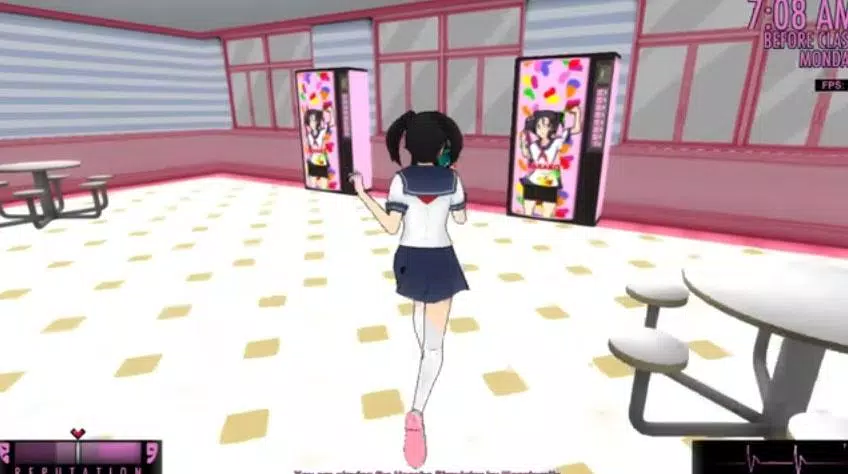
Yandere Simulator employs a moody, stylised visual approach that reinforces the game’s tense atmosphere. Environments are compact but detailed, designed to provide multiple paths, hiding places and interactive elements that support stealth play. Levels are built as discrete scenarios rather than sprawling open areas, making them suitable for shorter play sessions while still offering depth for exploration. Lighting, sound design and environmental cues play an important role in creating suspense and guiding player decisions.
Customization, Replay Value and Accessibility
The game offers replay value through scenario variety and multiple approaches to objectives: players can prioritise stealthy avoidance, timed interactions, or collecting items in a particular order to see different outcomes. Basic customization options allow adjustments to control sensitivity and difficulty to suit different play styles. Accessibility considerations include clear visual indicators for interactive objects, optional hints that can be toggled, and control mapping suited to one-handed play. These options help make the experience approachable without altering the core thematic tone.
Offline Play and User Experience
Yandere Simulator is structured for offline play, so sessions do not depend on network connections and are well-suited to mobile use on the go. The user interface focuses on clarity: a simple inventory display, contextual help prompts, and consistent feedback when actions succeed or fail. Loading times are kept minimal between scenarios to maintain momentum, and save options let players return to mid-scenario checkpoints. Be aware that the game contains intense themes and violent imagery that may not be suitable for all players; it is designed as a narrative-driven simulation for mature audiences interested in character-focused, morally challenging gameplay.
Show More