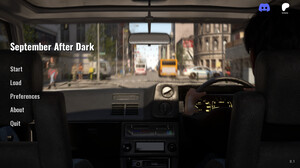
September After Dark
Version:0.1
Published:2026-11-18
Introduction
September After Dark is a narrative-driven indie game that places you in the shoes of a man who returns to his hometown after a decade away, moving back in with his grandparents and accepting a job while hoping to build a new life. September After Dark opens with a single, consequential incident that forces the protagonist to intervene, and from that moment the game focuses on close-up human drama, moral choices, and the quiet tension of small-town life. The writing emphasizes character relationships and atmosphere over spectacle, and the early release gives players a clear sense of tone and the creative direction the developer intends to pursue.
Key Features
September After Dark delivers a compact, character-led experience built around branching dialogue, scene-based exploration, and consequential decision points. The game centers on interpersonal storytelling: your dialogue options and actions shape how relationships evolve and determine which scenes you unlock. Instead of complex combat or open-world systems, the title offers tightly constructed chapters that mix exploration of familiar locations, conversations with a cast of grounded characters, and moments of tense decision-making that influence the narrative path. The debut release focuses on establishing mood, characters, and the first critical beats of the plot while leaving room for additional content in later updates.
Gameplay and Mechanics
Gameplay in September After Dark is driven by choice and discovery rather than fast action. Players navigate short, self-contained scenes where they examine environments, select dialogue options, and choose how to respond to events. The core mechanics include branching dialogue trees that track the consequences of key decisions, limited exploration segments that reveal context through environmental detail, and occasional pressure moments designed to heighten suspense by asking for swift but meaningful choices. Progression is narrative-based: advancing unlocks new chapters and reveals deeper layers of character backstory, and repeated playthroughs expose alternate outcomes and hidden interactions.
Controls and User Experience
The controls are simple and optimized for mobile: tap-to-select dialogue and interactive objects, swipe or tap to move between scenes, and on-screen prompts for contextual interactions. Menus are intentionally minimal so the story stays front and center, with clear indicators for save points and chapter progression. The interface includes options to adjust text speed, skip previously read dialogue, and review past conversation logs, which helps players pace themselves and revisit key details without losing immersion. Autosave and manual save slots are provided so you can pick up where you left off without worrying about losing progress.
Visual Style and Level Structure
Visually, September After Dark leans into an intimate, atmospheric aesthetic that supports the emotional tone of the story. Environments are composed with attention to small-town realism: dimly lit interiors, weathered streets, and close-up character portraits that emphasize expression and mood. The game is organized into short chapters that cover a sequence of connected scenes, each designed to focus on a particular relationship or dilemma. This structure keeps play sessions manageable while allowing the narrative to build steadily from personal moments to larger consequences.
Progression, Customization, and Replay Value
Progression is tied to narrative choices rather than leveling or equipment systems. Customization is reflected in how you shape the protagonist’s relationships and moral stance through dialogue and actions, which in turn unlock different narrative branches and alternate scenes. Because choices can lead to varied outcomes, the game encourages replay to discover different character interactions and endings. Hidden details and optional conversations reward players who revisit locations or take alternative approaches, increasing replay value without adding artificial grinding or microtransaction elements.
Accessibility, Offline Play, and Performance
The game includes accessibility options such as adjustable font sizes, subtitle toggles, and reduced motion settings to make the experience more comfortable for a broad range of players. September After Dark is designed to be playable offline once installed, so all core content can be experienced without a persistent network connection. Performance targets focus on smooth animations and readable text on a variety of Android devices; the compact release size helps keep load times short and battery impact modest.
Challenge Systems and Player Agency
Rather than traditional difficulty modes, the primary challenge comes from navigating moral ambiguities and the emotional consequences of your choices. Moments that test your judgment are framed by context and character reactions, and the game measures success by how believably the story responds to your decisions. These tension points create meaningful dilemmas where timing and tone of response matter, encouraging players to reflect on motivations and revisit the story to explore alternative perspectives.
Version Information
Version 0.1 of September After Dark introduces the main premise: a man returns to his childhood town, moves back in with his grandparents after accepting a job, and becomes entangled when he witnesses a consequential event that propels the narrative. This early build focuses on establishing core characters, the first chapters of the plot, and the decision-driven systems that will guide future updates. Players interested in character-led storytelling and atmospheric, choice-based scenes will find an intimate experience that aims to grow with subsequent releases.
Show More